Water versus Wine and Blood
The Satanic VersesWater versus Wine and Blood is a recurring symbolic opposition in The Satanic Verses, used to make religious conviction and political struggle legible through competing images of purity, life, intoxication, and violence. The Imam treats water as both moral principle and instrument of authority, opposing it to the wine and blood associated with Empress Ayesha and historical change. Yet the image does not settle into a simple promise of rescue: Gibreel’s dreams and the pilgrims’ journey to the sea leave the meaning of water uncertain, even as characters invest it with the power to transform their world.
Water as purity and discipline
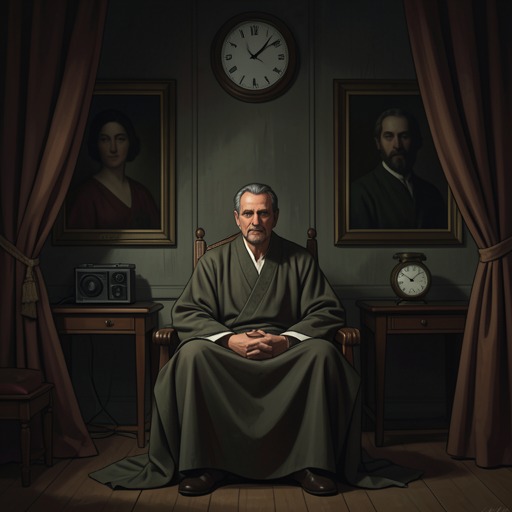
In exile, the Imam’s insistence on water takes a material, repetitive form. His son, Khalid, brings him a glass every five minutes; the Imam drinks constantly, and an American filtration machine purifies the water before he takes it. His followers know his Monograph on Water, which presents water’s purity, simplicity, and life-preserving function as qualities that can pass to the person who drinks it. The Imam’s attention to the glass and its preparation turns an everyday necessity into a rule of personal and religious discipline.
That rule is also a means of judging other people. The Imam contrasts his water-drinking with Empress Ayesha’s wine, describing the mixture of Burgundies, clarets, and hocks as a corruption that condemns her. A portrait in his bedroom reinforces the contrast: the Empress holds a human skull containing dark red liquid, while the Imam defines himself as a man of water. His religious argument thus gives the images a political charge. Water signifies the life he claims to protect; wine and blood stand for the ruler he opposes and the order he would overthrow.
The Imam’s account of water’s social value extends beyond his private habits. His Monograph presents it as something no civilized person may refuse to another, and invokes a grandmother rising to fetch water for a child who asks for it. In this formulation, water is a shared obligation as well as a substance of purity. The ideal of universal care, however, sits beside the Imam’s condemnation of opponents and his desire to command history. The image’s moral appeal and its use as political rhetoric remain intertwined.
Wine, blood, and the struggle over time
The opposition widens into a theory of history. The Imam associates wine with intoxication and historical movement, and water with life and a divine stillness beyond time. His followers hear this doctrine in a nightly broadcast carried on surreptitious radio waves: Bilal’s trained voice enters a ham radio in Kensington and emerges in Desh as the Imam’s revolutionary speech. The Imam presents the struggle not simply as a revolt against Empress Ayesha but as a revolt against history itself, rejecting progress, science, and rights as deviations from a completed revelation.
Bilal’s voice makes the doctrine portable. The Imam selected him partly for the beauty and authority of his voice, once celebrated in the hit parade; that same voice now serves a movement opposing the modern power with which the Imam associates it. In the broadcast, the contrast between water and wine becomes a contrast between divine eternity and the Empress’s changing world. The Imam imagines a revolution that will abolish clocks and birthdays, making everyone the same unchanging age in God’s sight. Water therefore signifies more than moral cleanliness: it becomes an emblem of escape from aging, historical sequence, and political rule as the Imam defines them.
In Gibreel’s dream, the revolution seems to arrive. The advancing crowd reaches the palace guards, and the weapons fall silent; the Imam declares the moment accomplished. The palace then becomes the setting for a supernatural transformation: Al-Lat emerges from the palace, falls, and leaves behind a dark stain. The clocks of the capital begin to chime beyond any ordinary measure, announcing the end of time and the beginning of the Imam’s Untime. The scene gives his opposition of water and wine a spectacular imagined conclusion, but its placement within Gibreel’s continuing dream narratives prevents it from functioning as an uncomplicated account of political reality.
Revelation, listening, and uncertain authority
Water also appears in the story of Mahound’s prophetic experience, where it is associated with a miracle but does not end doubt. Mahound recalls that Gibreel opened his breast, washed his heart in the waters of the Zamzam Spring, and replaced it in his body. He also recalls his Night Journey to Jerusalem and the reduction of the faithful’s daily prayers from forty to five after he returned to plead for a lighter burden. Despite these wonders and concessions, he asks why the people still worship Lat, Manat, and Uzza. Water belongs here to an account of purification and divine favor, but Mahound’s anguish turns the scene toward a question of belief: visible signs have not compelled the response he hoped for.
Salman the Persian cautions Mahound that accepting Abu Simbel’s offer to recognize the goddesses could make the revelation appear tailored to political advantage. Mahound answers that his listening is also a kind of asking and that Gibreel often seems to come from within his own heart. The account of water washing the heart therefore sits beside a broader uncertainty about where prophetic speech originates. The novel links the water image to purification without making it proof that either a revelation or its interpretation is beyond question.
The sea as promise and unresolved outcome
The later pilgrimage plot turns water into the destination of collective faith. After returning to Titlipur, Ayesha tells the panchayat that Gibreel has brought a command: the whole village must walk to Mecca, and at the sea the waters will open so the pilgrims can cross the ocean floor. The panchayat accepts the command unanimously. The villagers prepare provisions, bedding, cooking utensils, animals, and carts, while agreeing that the people themselves must walk and that only the youngest infants will be carried. Mirza Saeed objects, delays the preparations with angry speeches, and finally leaves as the departure plans continue.
The journey tests the promise against physical and social hardship. The pilgrims move at the pace of the slowest, manage illness and harassment, and cover about two miles on a good day. By the ninth week, journalists, politicians, advertisers, tourists, and other onlookers have gathered around them. The butterflies that clothe Ayesha and provide her food confound visitors’ expectations, while religious extremists denounce the pilgrimage as an appropriation of national tradition. The water promised as a route to salvation is thus already a public and political symbol, contested by observers who dispute the meaning and ownership of the pilgrimage.
When the pilgrims finally reach the Arabian Sea, they walk into it and disappear beneath the surface; none reappears. Mirza Saeed, Osman, Srinivas, the Sarpanch, and Mrs. Qureishi enter the water in an attempt to help, but are pulled or dragged back to shore. Saeed continues diving until he is rescued, exhausted and faint. The pilgrimage ends, and the surviving participants are questioned by the authorities, who consider whether to charge them with attempted illegal emigration. The promised opening of the sea is neither confirmed as a visible miracle nor simply erased: the disappearance gives the water’s promise a terrible, unresolved outcome. Across the Imam’s political vision, Mahound’s troubled recollections, and the pilgrims’ final approach to the sea, water remains at once a source of life, a sign of faith, and a medium whose power no character can fully control.